Music can say more than words.1 And regularly, the words that are used in songs are able to communicate so much that a piece of narrative literature of equivalent length simply cannot convey. During the week-end I read a short story where this characteristic of music was used to great effect. In the wholesome tale “Let All the Children Boogie” by Sam J. Miller, references to the music and lyrics of David Bowie and Iggy Pop were employed with great effect to communicate dreams, emotions, and hope.2 The change of perspective on the world and life that this brief adventure of two young outcasts in the early nineties can engender in the reader was, according to my opinion, in large part due to the use of those musical references. And such a change of perspective – including some of the same themes! – can also occur when listening to our topic of this week’s blog, the song “Time” by the British rock band Pink Floyd from their acclaimed as well as wildly successful 1973 album The Dark Side of the Moon.3
Much ink has already been spilled over the legacy of this legendary group and I reference these works in the footnotes when needed. But even more than interpreting the available textual, archaeological, and other kinds of evidence while reconstruction our shared history – as is normally the subject of this blog – any and all opinion on music can open new ways of enjoying and learning from it, no matter the ultimate substantiation. And that is what we are going to do today: learn from a layered and beautiful song, despite not trying to reinvent the dj set.
This blog is also available in Dutch.
Wasted Youth, Hurried Adulthood
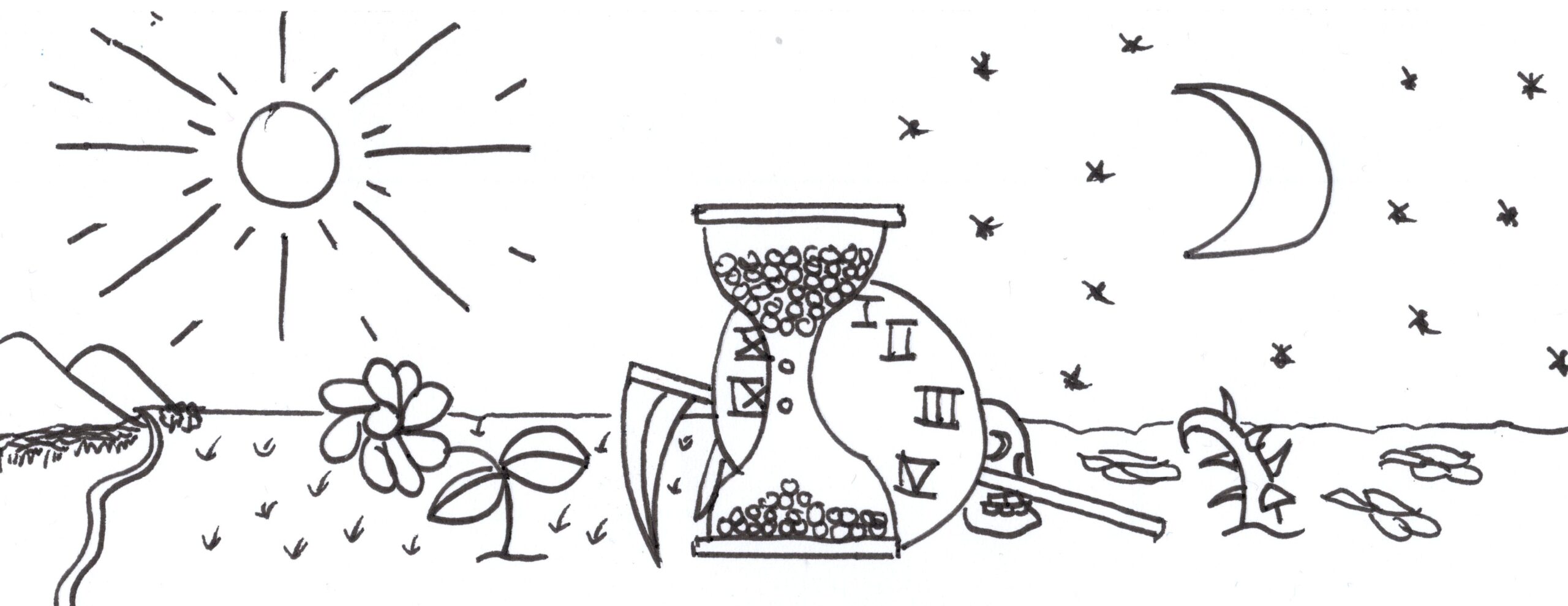
The song’s slowly building intro culminates with an overwhelming cacophony of all kinds of antique clocks that make various sounds to indicate the passing of yet another hour.4 But when the first lyrics are sung, they are about a young person, who has so much time at their disposal that they do not know what to do with it. And this is not an uncommon theme for Pink Floyd to explore. Almost all of their more famous music – from the psychedelic The Piper at the Gates of Dawn to the juggernaut that was the album The Wall – addresses childhood in the relatively oppressive atmosphere of post-war Britain.5 It is therefore perhaps fitting that the music to this song was written by all then remaining band members, that being David Gilmoure, Nick Mason, Roger Waters, and Nick Wright. The lyrics, on the other hand, are solely credited to Waters, who was also the driving force behind the aforementioned album The Wall. And he later explained how he himself had spend so much of his life, just waiting for something to happen. But the seas of time as well as – mercifully – the accompanying boredom would not last. In that sense, the clocks can be described as an awakening.6
And throughout the rest of the song, the shadow of death unfolds over both our nameless protagonist as well as the listener. The march of minutes, hours, days, weeks, months, and years, reveals itself as indefatigable and ever-present – a suffocating constraint instead of something that you can afford to waste.7 After you have realized the scarcity of that most precious of resources, time, you can try as you may – but every year you are left over with so many plans, ambitions, and experiences that have yet to come to fruition.8 But the song appears to finish on a comforting note – literally, if we consider the chords!9 – because the peace of old age comes to all of us. If we are lucky, that is! While the song ends, we are treated to a reprise of an earlier song on the album, which may indicate the eternal renewal of life.10 Perhaps a consolation for the unimaginable but unavoidable moment that we ourselves are ultimately gone and the world just keeps turning.
Time, Time, Time
In her overview of the mood within British Rock & Roll at the beginning of the seventies, Sheila Whitely notes how The Dark Side of the Moon, reflects a loss of optimism throughout this era. The album fittingly tackles dour themes, besides growing old there is the stranglehold of money on one’s life, the inescapable drudgery of work, and the looming madness behind it all that may engulf us at any moment.11 Similar to the earlier track “Breath” – the one I mentioned above, flourishes of which can be heard at the end of “Time” – we learn how society and its expectations may eventually take over a person’s entire being.12 It is therefore perhaps not exactly a blessing that the themes from this song have proven as timeless as the musicianship and lyricism employed!
But none of the other ideas explore in this song is, at least to my mind, as interesting as the idea that time passes faster when you become older.13 As the lyrics themselves go:14
The sun is the same in a relative way but you’re older,
Shorter of breath and one day closer to death.
Every year is getting shorter never seem to find the time.
And this is not an uncommon sentiment. You often hear it shared in social settings – especially when you are ancient, like me! And this sentiment appears to have a basis in psychology. As Douwe Draaisma notes in his fittingly titled book Why Life Speeds Up As You Get Older: How Memory Shapes Our Past, that it is not time that moves faster – it is our perception of it. In our youth, our new experiences are a larger percentage of our overall life than when we grow older. But, perhaps more importantly, our earlier years contain more ‘milestones’, so to say. We have many first experiences, like entering education and discovering friendship. While after the first two decades of our existences many of us – voluntarily or otherwise – settle in a routine. And time may feel endless when nothing really happens, but when taken together over a longer period such years shrink to a subjective blink of an eye. So, not only do our experiences when we live through middle age and beyond constitute a smaller part of all our adventures, they also regularly have less impact on us than what we already encountered.15 It is more of the same old and so our remaining time continues to contract.
Our problem then, as it is addressed in “Time”, is that we are young for a long time and old only for a little while. And this is one of the lessons I have taken away from both the works of Draaisma and the songs of Pink Floyd: do not settle for a routine if you can in any way avoid it. Because you may not be able to outrun the proverbial clock, but by keeping as much variation as possible in your own minutes, days, weeks, months, and years, as well as by seeking experiences with a similar or even greater impact than all the firsts we encountered when we were youngsters, we can at least slow down our subjective experience of time.
Conclusion: Time Comes For Us All
The last verse of “Time” mentions that “hanging on in quiet desperation is the English way.”16 But here I would have to disagree with mister Floyd – am I allowed to say Pink?17 – because that sentiment applies, I think, to everyone who is aware of the gnawing teeth of time. And this universality is perhaps never more apparent than on the track that follows “Time” on the album: “The Great Gig in the Sky” offers an intuitive feeling of humanity, beauty and perhaps even rebirth.18 To try it all over in a next life or during a different existence on another timeline, perhaps. And for a while we can imagine escaping the ultimate bane of humanity and getting a second chance at it – a second chance that perhaps only music can offer.19
The Dark Side of the Moon is a remarkable album, which rewards attention and – ironically – places our daily lives in a whole new light, which we may not have considered earlier.20 Listening to such music can be one of those impactfull experiences which deviate from our daily routines that make time slow down again. And the same, I hope, is true for reading these blogs on Bildungblocks!
References
- A notion that holds especially true for the genre which encompasses the song that we discuss today, see: Sheila Whiteley, The Space Between the Notes: Rock and the Counter-Culture (London: Routledge 1992), p. 3.
- Sam J. Miller, “Let All the Children Boogie”, in: Rebecca Roanhorse (ed.), The Best American Science-Fiction and Fantasy 2022 (New York: Mariner Books, 2022), p. 148-166.
- Lawrence K. English. More Than Music: Cultural Stirrings of Pink Floyd’s The Dark Side of the Moon (New York: Algora Publishing, 2021), p. 2.
- Nicholas Schaffner, Saucerful of Secrets: The Pink Floyd Odyssey (London: Helter Skelter 2005), p. 157; Whiteley, The Space Between the Notes, p. 3. For the entire intro, see: Shobana P. Mathews & Vishal Varier, “Pink Floyd’s Time: An Aural Narrative that Explores Aspects of Time through Lyrics and the Disruption of Music Memory”, Gedrag & Organisatie Review 2020, 33 (2), p. 2120.
- For The Piper at the Gates of Dawn and The Wall, see: Whiteley, The Space Between the Notes, p. 29-31, 114.
- Jean-Michel Guesdon & Philippe Margotin, Pink Floyd – All the Songs: The Story Behind Every Track (New York: Black Dog & Leventhal, 2017), p. 306; Mathews & Varier, “Pink Floyd’s Time”, p. 2121.
- Mathews & Varier, “Pink Floyd’s Time”, p. 2122.
- Whiteley, The Space Between the Notes, p. 108.
- Ibidem.
- Guesdon & Margotin, Pink Floyd – All the Songs, p. 308. But this may be a false sense of security, see: Whiteley, The Space Between the Notes, p. 108.
- Ibidem, p. 104. See also: English, More Than Music, p. 1.
- Whiteley, The Space Between the Notes, p. 107; Mathews & Varier, “Pink Floyd’s Time”, p. 2122.
- Tricia M. Kress, “The Dark Side of the Prism: Pink Floyd’s Dark Side of the Moon and the Pedagogy of Neoliberal Capitalism Dark”, in: John Austin (ed.), Spinning Popular Culture as Public Pedagogy: Critical Reflections and Transformative Possibilities (Leiden: Brill, 2017), p. 67.
- English. More Than Music, p. 49.
- Douwe Draaisma, Waarom het Leven Sneller Gaat als Je Ouder Wordt: Over het Autobiografische Geheugen (Groningen: Historische Uitgeverij, 2001), p. 215-228. My reference here is to the original edition which was in Dutch, as that is simply the one at my disposal! For approximately the same passage in the English edition, see: Douwe Draaisma, Why Life Speeds Up As You Get Older: How Memory Shapes Our Past, Translated by Arnold & Erica Pomerans (Cambridge: Cambridge University Press, 2012), p. 200-224.
- English. More Than Music, p. 49.
- Fun fact: according to drummer Nick Mason the band is named after two blues musicians, Pink Anderson and Floyd Council, see: Nick Mason, Inside Out: A Personal History of Pink Floyd (London: Weidenfeld & Nicolson, 2005), p. 33-37.
- Whiteley, The Space Between the Notes, p. 109.
- On the notions of death, fear, and making something of oneself while under that twin doom, that I implicitly referenced in this paragraph, see: Paul Tillich, De Moed om te Zijn (Utrecht: Bijleveld, 2004), p. 45-59.
- English. More Than Music, p. 4.