A while back we talked about the video game Tiny Glades and how the artifice of the landscapes you could create there showed how ‘nature’ is not a faraway sequestered space free of any and all human interference. On the contrary, in our Anthropocene age every environment, every biome, and even every imaginable place on earth is directly or indirectly, largely or in part, shaped by human influence.1 And this makes the topic I selected for this week’s blog, discussing some songs about escaping to nature, also theoretically interesting.2 Because if nature is not an unequivocally uniform concept, can it even be a shared refuge where all those artists envision themselves going? And it does indeed turn out, that very distinct kinds of nature are serenaded in these songs. Moreover, there is a field we can turn to, if we want to explain these differences: ecomusicology. So let us today survey that field and those songs in order to find out what an escape to nature would actually mean in a world where forests are as much an environment shaped by humankind as your average suburb.
This blog is also available in Dutch.
Ecomusicology
Those researching ecomusicology, despite what the name would suggest, are not simply looking for ecological references in songs. As ecomusicology is one of the many fields indebted to ecocriticism, these researchers look at their subject through an – you guessed it – ecocritical lens.3 That is to say, they have certain interests that lead their inquiries. These interests often pertain to the cultural norms regarding the environment that can be found in music and which are in turn often influenced by earlier musical products themselves.4 And this includes the disparate ideas of nature that we can find in a lot of songs.5 To catalogue these ideas could therefore be a versatile academic pursuit.
And though such endeavors are interesting in and of themselves – you are reading about this in your spare time, for example – they also serve a more immediately useful purpose. Ecomusicological analyses of songs may assist us, for instance, in researching how our social and ecological crises are reproduced in our pop culture and subsequently shape our reaction to such problems, however intangible.6 Often we have to use a fine comb in order to dissect such themes, if and when they are present in our pop songs. Because, as Mark Pedelty writes, “Many producers, distributors, and audiences consider environmental themes to be ideologically tendentious” and that has had repercussions for the available music written in this vein.7 Though, this has not stopped those interested in the relationship between music and nature from trying to analyse the proverbial crumbs that are available – from antiquity until the present day.8 And that is why such a more obscure route as I have chosen today, to search for different ideas of nature in songs about escaping the less desirable aspects of our daily lives, may indeed prove fruitful.
Trading the City for the Wilderness
Much of the research in the field of ecomusicology pertains – understandably! – to the current climate crises and the role of music in efforts to conserve environments that are considered natural.9 But this is not as straightforward as it sounds. In the Anthropocene, as stated above, any and all environments can be said to have been influenced by human activities – even if we would merely consider that the makeup of our world’s atmosphere has drastically changed through our actions as a collective force.10 As such, the difference between the natural world and ours is, at best, one of degree. And we do indeed see that many of the songs about escaping the rut of daily life for nature, can better be described as advocating for swapping an overwhelmingly built environment – such as a big city or dilapidated town – for one that is dominated by trees, grasses, waterways, and the more traditional abodes of animals and critters than those provided by overtly human-made structures.
Two of the most beautifully worded examples of such an approach to nature, in which artists long for escaping the build environment as a reminder of all the human busywork that is conducted there, are the songs Lake Louise by Abel Hawnt and 3 A.M. by Gregory Alan Isakov.11 Both artists lament the monotonous life and jobs in the city and envision themselves roaming through the wild. Their metaphors reflect this attitude: Isakov knows he still needs shoes, just not the once made for standing. And Hawnt, just like many of us, aims to lose less days to screens. And when children dream of running away, as in the second verse of The Trapeze Swinger by the musical project Iron & Wine, they often envision their natural refuge only in the broadest of terms.12 But there is a catch here, did you see it? In the first place, your job needs to a certain extent be connected to the city for such an escape to – literally – greener pastures to be a real getaway. Moreover, a temporary sojourn into nature may not be relaxing for many people. For them it is the amenities of the city that help put their mind off things. Luckily, there are other ideas of nature in the songs that they can listen to!
Music about Being in Nature
Because an escape to nature may be more than a distraction from the monotonous city life. Instead, nature can be viewed not in contrast with another environs, but as a thing unto itself. Where you’d go, even if city life treats you tolerably. It can provide a fresh start with a different outlook, for instance. This is what we encounter in songs that chronicle the beauty of places where human influence is perhaps as pervasive as elsewhere, but where we simply do not notice it because of the overwhelming allure found therein. This beauty is not more natural, one could argue, than a skyscraper. But the primordial elements present – like mountains and large bodies of water that humans mostly have affected in ways that are less visible to the naked eye – give it an appearance that inspires anyway.13 That awe and the beauty that we can see therein, has famously been sung about.
If I confine myself to one example, I have to mention John Denver. This was a country artist and environmental activist whose songs about the rural and wild areas of the United States of America even became the very anthems for some of the locales which host that natural splendor.14 Some songs go beyond mere praise for the beauty of nature and provide a structure for a life that may be a proper substitute for the old one. Chris Remo’s Ol’ Shoshone, which was recorded for the video game Firewatch that we discussed last year, is one such song. In this tune the verbiage of city life is projected onto the wild. As such, life there does not have to be inferior to an existence in a more densely built environment.15 And this leads to another idea: can a different built environment also be a kind of metaphorical nature that offers the escape from an earlier routine that so many songwriters seem to aspire to?
And there are indeed songs that hinge on such a wildly expanded idea of nature, which would include certain kinds of build environments. In those songs we are still escaping one build environment, but we are traveling through or to another one. Though these are often associated with less human-made structures – what we would call ‘nature’ in the more pedestrian meaning of the word – it is still the built environment that offers the escape.16 Two excellent examples can be found in the game franchise Road 96, which is about youngsters trying to escape an oppressive regime by traveling the open road.17 The most clear example of the two songs, is The Road by folk-pop duo Cocoon, where it is the feeling of independence that being alone in a less densely populated area entails, which takes central stage. The other song, Land Locked Heart by the band The Midnight, covers a similar sentiment but stresses the life-affirming aspects of exploring a new environs.18 Taken together, these songs are concerned with nature insofar as it is a place where less people congregate and the built environment is markedly different from other more densely populated places. And a part of this, as you can imagine, are the prevalent sounds. While cities tend to be loud, less packed built environments are less so. And they may also create their very own music.
The Music in Nature
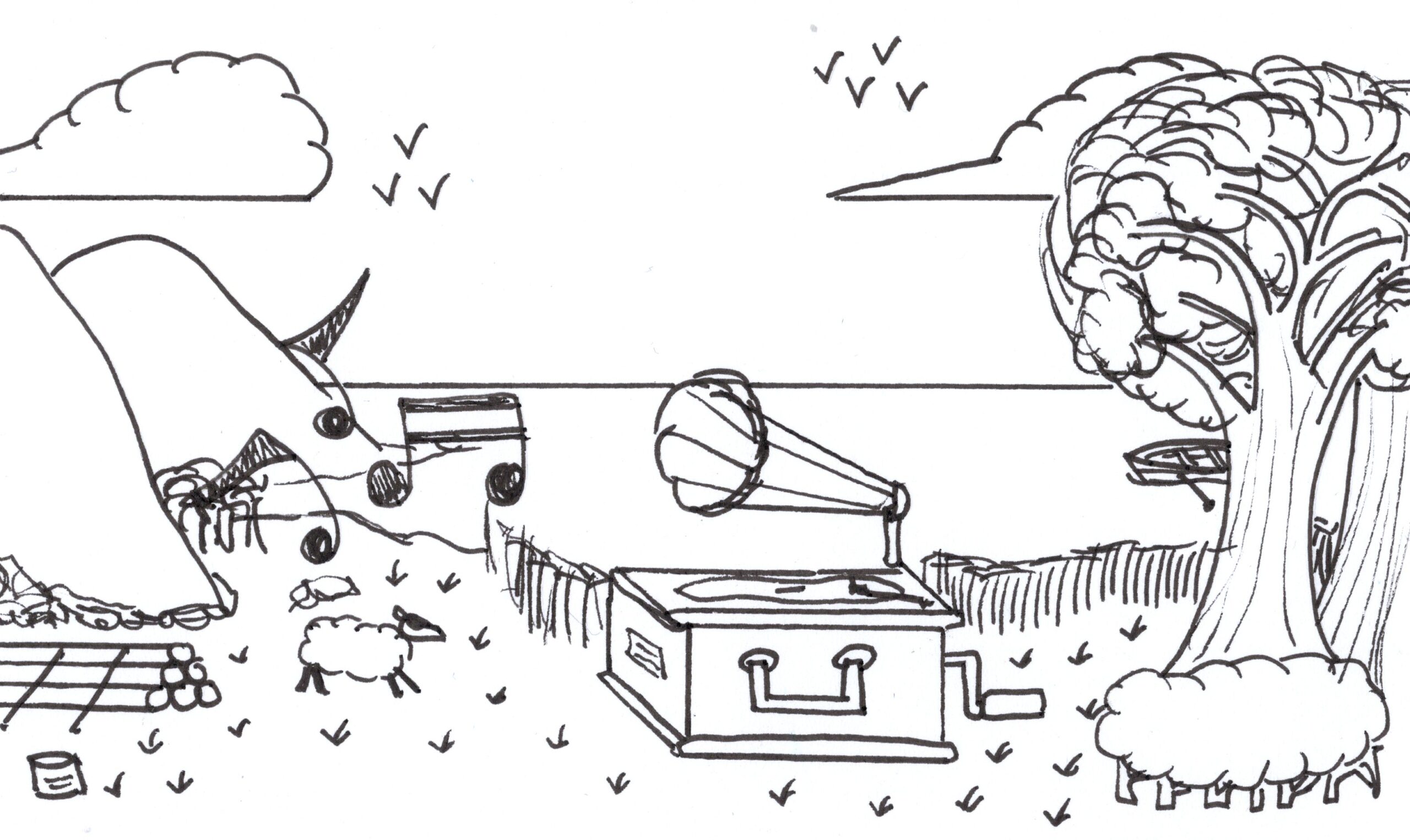
Thus, as the last point today, I need to discuss a category of songs which incorporate the music that can be found in the environments that most people consider natural in the ordinary sense of the word. That there is music in nature – tunes that involve flora and fauna and which humans can perceive and enjoy – is already appreciated since at least antiquity. In the Epic of Gilgamesh, for example, the titular hero and his companion Enkidu experience the manifold songs of the birds and the rhythms made by the monkeys in the cedar forest that is guarded by the fearsome Ḫuwawa.19 And there are modern songs wherein nature is perceived as the compilers of this epic did: as a source of music.
These songwriters incorporate what they find in the non-human world into human stories. But this does not necessarily have to mean that the aforementioned demarcation between the natural and build environments is very strict or even present.20 On an interlude in nature on the album My Light, My Destroyer by Cassandra Jenkins, the sounds of the environment are combined with the sound of human voices that describe what they see, for instance.21 Haley Heynderickx meanwhile, while translating wilder environments into a medium that people more readily understand, very sharply observes how human sounds are part of the background music of our existence. In a song about Redwood Trees, for instance, she incorporates cell phone sounds!22 Thus, even if there is no natural world that is separated from ours, there is still music to be found outside our everyday lives and abodes – but sometimes the tunes were with us all along.
Conclusion: Where Nature Is
As you probably have guessed by now, I did sneak in some lighthearted education on the environmental humanities, the overarching discipline to which ecomusicology is generally said to belong, in the preceding paragraphs. And this should not come as a surprise, because the body of research that constitutes the field of ecomusicology can help the inquiries by those active within the ecological humanities about the place of humankind in nature as a deeply interconnected part of it.23 I suspect that involving such a theoretical framework when talking about music, enriches the reading experience. Because, as we all try to grapple with the “political, social, economic, and ecological problems affecting today’s world”, music can be one delightfully informal avenue to understand some of these problems and inform others about them.24 And this includes a – excuse the pun – natural way to teach people that words like ‘nature’ may have very particular meanings that they may not have been aware of before they listened to certain songs.25
And the knowledge we have gained through that theoretical framework and the subsequently enriched reading experience also heightens our enjoyment of music, I’d wager. Including all those classic songs about different kinds of nature that I could not include!26 Because now that we have a deeper understanding of the disparate ideas about nature that may be serenaded in the tunes on our radios, audio storage devices, and streaming services, we can apply that understanding to new songs we hear and develop an even deeper appreciation of the melodies that lighten our daily routines and lives. In fact, with enough good music around, who would even want to escape to nature?
References
- Steven Vogel, Thinking like a Mall: Environmental Philosophy after the End of Nature (Cambridge: MIT press, 2015), p. 4-8, 129-131.
- Mark Pedelty, Rebecca Dirksen, Tara Hatfield, Yan Pang & Elja Roy, “Field to Media: Applied Ecomusicology in the Anthropocene”, Popular Music 2020, 39 (1), p. 22-23.
- Aaron S. Allen, “Ecomusicology: Ecocriticism and Musicology”, Journal of the American Musicological Society 2011, 64 (2), p. 393.
- Aaron S. Allen & Kevin Dawe, “Ecomusicologies”, in: Aaron S. Allen & Kevin Dawe (eds.), Current Directions in Ecomusicology: Music, Culture, Nature (Abbingdon: Routledge, 2016), p. 4.
- Mark Pedelty, “Pop Ecology: Lessons from Mexico”, in: Aaron S. Allen & Kevin Dawe (eds.), Current Directions in Ecomusicology: Music, Culture, Nature (Abbingdon: Routledge, 2016), p. 200.
- James R. Edwards, “Critical Theory in Ecomusicology”, in: Aaron S. Allen & Kevin Dawe (eds.), Current Directions in Ecomusicology: Music, Culture, Nature (Abbingdon: Routledge, 2016), p. 153; Aaron S. Allen, “Prospects and Problems for Ecomusicology in Confronting a Crisis of Culture”, Journal of the American Musicological Society 2011, 64 (2), p. 414; W. Luke Windsor, “Nature and Culture, Noise and Music”, in: Aaron S. Allen & Kevin Dawe (eds.), Current Directions in Ecomusicology: Music, Culture, Nature (Abbingdon: Routledge, 2016), p. 166-169.
- Pedelty, “Pop Ecology”, p. 208.
- Allen, “Ecomusicology”, p. 391.
- Jeff Todd Titon, “The Nature of Ecomusicology”, Música e Cultura 2013, 8 (1), p. 8-18; Thorsten Philipp, “Sounds of Remembered Nature: Narrating Environmental Change Through Pop Music”, in: Frederico Dinis (ed.), Performativity and the Representation of Memory: Resignification, Appropriation, and Embodiment (Hershey: IGI Global, 2024), p. 274.
- Vogel, Thinking like a Mall, p. 17. See in general: Timothy Morton, Dark Ecology: For a Logic of Future Coexistence (New York: Columbia University Press, 2018).
- For these artists, see: Editorial Board, “Abel Hawnt – Lake Louise (Feat. Luke Beling)”, Indiemusiccenter.com (retrieved 24 April 2025) James Christopher Monger, “Gregory Alan Isakov Biography”, Allmusic.com (retrieved 24 April 2025).
- Andrew Leahey, “Around the Well Review”, Allmusic.com (retrieved 25 April 2025).
- Vogel, Thinking like a Mall, p. 128, 135, 137-144, 171; Erle C. Ellis, Anthropocene: A Very Short Introduction (Oxford: Oxford University Press, 2018), p. 58-60, 70.
- Jason Ankeny, “John Denver Biography”, Allmusic.com (retrieved 25 April 2025); Redactie Cultuur, “’Country Roads’ is Officieel Volkslied”, Dagblad van het Noorden 12 March 2014, Cultuur, p. 30.
- Campo Santo Games, “Ol’ Shoshone: From Firewatch Original Score by Chris Remo”, Camposantogames.bandcamp.com (retrieved 25 April 2025).
- Vogel, Thinking like a Mall, p. 144-147.
- Zsófia Orosz-Réti, “From Superhuman to Posthuman: Collective Action in Single-Player Video Games”, Proceedings of DiGRA 2023 (Presented paper), 20 (1), p. 2-3.
- Various Artists, “Road 96 Original Soundtrack”, Road96.bandcamp.com (retrieved 25 April 2025); The Midnight, “Land Locked Heart (from Road 96: Mile 0)”, themidnight.bandcamp.com (retrieved 25 April 2025). For these artists, see: Jason Birchmeier, “Cocoon Biography”, Allmusic.com (retrieved 25 April 2025); Timothy Monger, “The Midnight Biography”, Allmusic.com (retrieved 25 April 2025).
- Farouk N.H. Al-Rawi & Andrew R. George (2014), “Back to the Cedar Forest: The Beginning and End of Tablet V of the Standard Babylonian Epic of Gilgameš.”, Journal of Cuneiform Studies 2014, 66 (1), p. 74, 76-77.
- Linda Nash, “The Body and Environmental History in the Anthropocene”, in: Ursula K. Heise, Jon Christensen & Michelle Niemann (eds.), The Routledge Companion to the Environmental Humanities (Abbingdon: Routledge 2017), p. 403; Brian Alexander Karvelas, Listening to Landforms: Intersections of Ethnomusicology and the Environmental Humanities (Santa Barbara: University College Santa Barbara Thesis, 2019), p. 7.
- Timothy Monger, “My Light, My Destroyer Review”, Allmusic.com (retrieved 24 April 2025).
- Marcy Donelson, “Seed of a Seed Review”, Allmusic.com (retrieved 24 April 2025).
- Allen & Dawe, “Ecomusicologies”, p. 5.
- Timothy Rice, Modeling Ethnomusicology (Oxford: Oxford University Press, 2017), p. 205.
- Anthony Seeger, “Natural Species, Sounds, and Humans in Lowland South America: The Kĩsêdjê/Suyá, Their World, and the Nature of Their Musical Experience”, in: Aaron S. Allen & Kevin Dawe (eds.), Current Directions in Ecomusicology: Music, Culture, Nature (Abbingdon: Routledge, 2016), p. 89.
- Most famously perhaps The Beatles’ Mother Nature’s Son, see: Stephen Thomas Erlewine, “The Beatles [White Album] Review”, Allmusic.com (retrieved 25 April 2025).