Here in the Netherlands it is the perfect weather to cozy up in a chair by the fire and lose yourself in a book – unless you are a big fan of cold, rain, and ill-timed gusts of wind, that is! And the more pages such a book encompasses, at least in my experience, the better it can help you to forget the outside world for a while. Which nicely ties in to a question that I got from one of the readers of the Bildungblocks-newsletter and which I want to discuss with you today: How hefty were Roman books?1
This blog is also available in Dutch.
Reading in Rome
For as unfathomably long the time span is that we have information about the Romans and their history, the first complete work of literature that survived to the contemporary period is only dated to around 200 years before our common era.2 And even then it was not a book as we mostly imagine them today – it was a set of comedic plays!3 But we do know that the written word in the Roman Republic and later the Roman Empire took various forms throughout different genres, periods, and locales.4 Perhaps unsurprisingly, it is this fascinating variety which makes our question rather difficult to answer and justifies dedicating an entire blog to my attempt to do so anyway.
Let us, for the moment, assume that today we are mostly interested in narrative literature. That is to say, a book which you are supposed to read – or hear read out lout – and which is not an instruction for an activity, nor a vehicle for rhetorical persuasion or otherwise meant to be anything else than informative, enriching, and entertaining. Which does not mean that authors did not have any kind of underlying purposes with their works, of course.5 This leaves us with a surprising variety of Roman reading material. One could for example read an epics – like The Aenead about the Trojan hero Aeneas being a forebear of Rome – delve into all kinds of history – from military to moral – or even explore some speculative fiction. And it appears that many of the proper fictive novels that emerged emulated these genres.6 Though this kind of literature was not the most prevailing written output.7
Book such as these could be acquired through a variety of methods. One could visit a library, if so inclined.8 But if you had some cash to spare, a Roman infected with the reading bug could also partake in the lively book trade. To get the best books, though, it was pertinent to know some rich countrymen. Because many of the books in circulation in Roman times were produced through the work forces that were employed, willingly or unwillingly, by the primarily male upper layers of society.9 And not seldom, these were copies of these rich guys’ very own work!10 Lastly and most grimly, books could be acquired through confiscation and as booty during raids and other conflicts.11 Books as political detainees or prisoners of war, so to speak. But how hefty were those books one could eventually access by legitimate or less legitimate means?
Booklets, Books, and Tomes
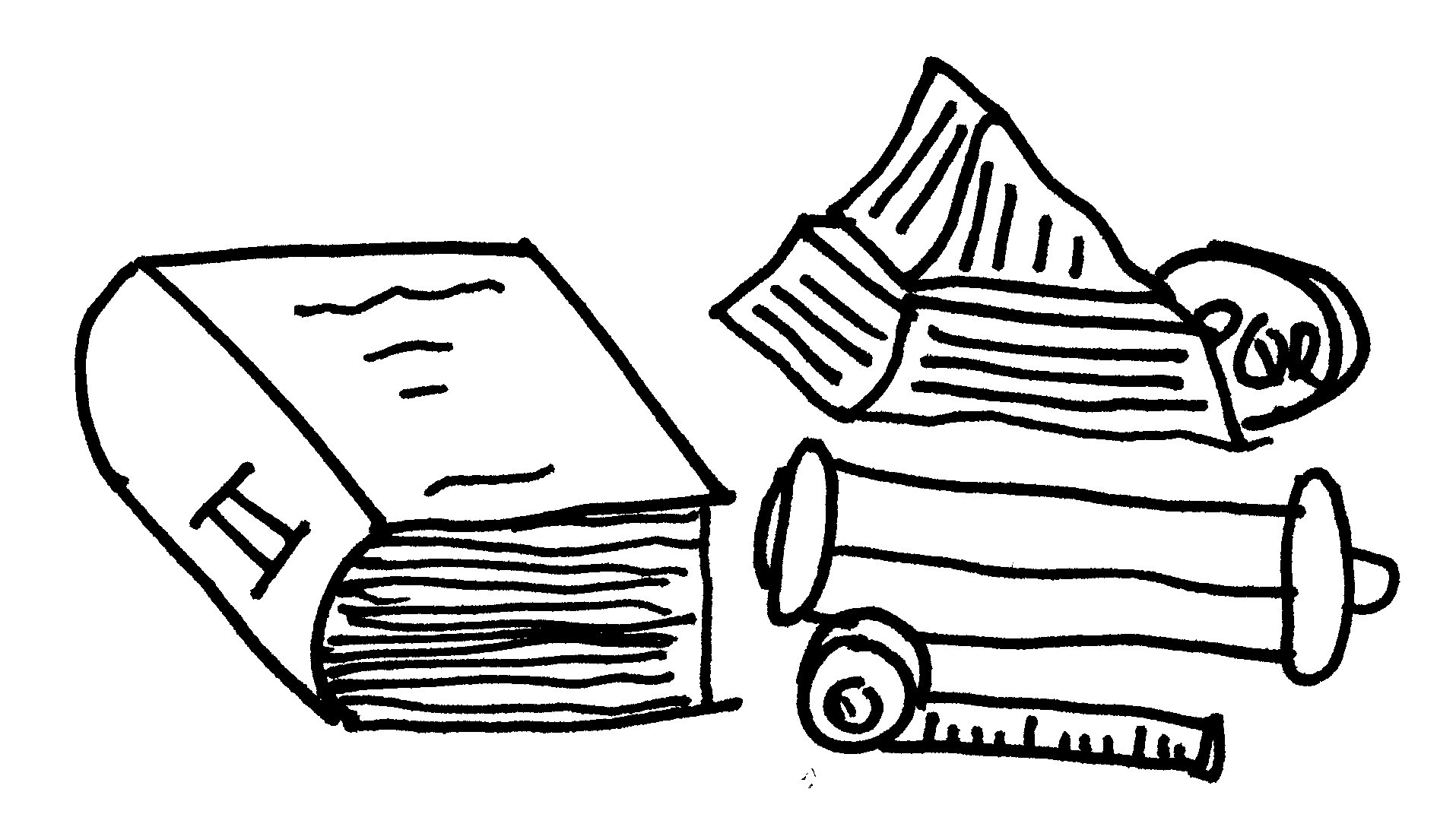
In his popularizing book on the subject – titled with an endearing directness The Roman Book – Rex Winsbury wisely start with the question what a Roman book would be?12 If papyrus scrolls or book rolls count, for example, we do not have surviving copies for which we can add up the words; though we can make estimates.13 Furthermore, if we want to focus on books as we mostly perceive them – that being codices with pages that are supposed to be turned, protected by two covers – we are in for a bit of trouble. Because this format, called a codex, was only adopted towards the end of the Roman Empire in western Europe – or what most people would propose to be the fall of Rome and thus the end of the Roman books they are primarily interested in. And then there were all those other writing materials, from wax to wood. Even the Latin word for book, Liber, references such an alternative reading material; the word comes from the supposed old custom of writing on bark.14
As such, we are mostly stuck with the scrolls and the rolls – volumen in Latin – and we are thus confronted with the unenviable task to gauge their, well, volume.15 Though first we need some further caveats. As there are reasons to wonder whether a fair comparison can be made at all. Because of the cavalier attitude in the Roman world towards book production, an author could seldom be sure about the way in which their works were copied – including how many words would remain.16 But if we allow ourselves to speak in generalities, we find that the length of any Roman work could differ enormously. It is true that one physical scroll or roll had only so much room and we have several estimates how long a normal scroll was – from the ancient writer Pliny’s 5 meters, to modern estimates based on Egyptian fragments that range between 10 and 15 meters.17 This does not help us, however, as books could easily take up multiple scrolls.18 And the amount of words on those connected papyrus sheets could also vary widely. There were, for example, scrolls with larger and better legible writing for those with bad eyesight or just to avoid straining one’s eyes.19
If we want to use a fairly objective standard and measure the length of Roman books by words alone, it is interesting to know that contemporary data annalists who processed the surviving texts, estimate that from the period up until the third century CE we have about ten million Latin words left.20 To give you an idea, our ancient Greek corpus contains roughly fifty-seven million words, the ancient Egyptian corpus is about six million words, and on the 550.000 objects that are inscribed with cuneiform signs it is estimated that some fourteen million words were written in several languages.21 To put that number in even more perspective, the amount of Latin words would yield only twenty copies of J.R.R. Tolkien’s The Lord of the Rings! Sadly, precious few Roman texts have survived. And within these preserved or endlessly copied manuscripts, literature is a small minority.
This still does not tell us, though, how long individual works were. Which brings us to yet another caveat: the amount of words may also vary on the kind of work that was put on a scroll. Poetry, for example, was often collected but such a collection presumably have taken up less space than prose.22 And even within genres, there could be a wide variety. Not every work of history was as voluminous as Livy’s, whose Annales took up more than a hundred scrolls. Perhaps a better metric, which is often used by those studying ancient Rome, are lines. If we follow Richard Rutherford and assume that scrolls mostly contained between 1000 and 2000 lines, and combine this assumption with the observation that Roman books could occupy multiple scrolls, we can conclude that the books with narrative literature back in Roman times could be as long as hundreds of thousands of words!23 Thus, when it comes to the amount of words in a Roman book, the answer is simple: we don’t know and have – as far as I could find – no way of knowing as of today. But we do know that these books could be as short and as long as anything you can find in a contemporary book store!
The preceding remarks perhaps appear a bit basic. But it is important to realize that there is much we don’t know. One heartbreaking example is that we only have the works of two Roman women. But there are indications, in the frescoes of the excavated city of Pompeii and references by the surviving works of male authors, that at least a minority of the fairer sex did read and write.24 In fact, the noble woman Caerellia was such a ferocious reader, that she got a hold of Cicero’s newest philosophical work before the latter had managed to publish it – to the chagrin of the writer!25
Conclusion: The Endurance of Books
Even in a time that we are increasingly glued to their screens – you know the one’s: there is the small vertical rectangle you can hold in your hand, the larger horizontal rectangle which comes with a mouse and keyboard, and the biggest of them all hangs on the wall to glance at while mostly looking at the first screen I mentioned – books still seem to capture the imagination of many. Take one of the main sources that I used for this blog, Papyrus: The Invention of Books in the Ancient World by Irene Vallejo.26 This book, originally written in Spanish, was a veritable commercial success when it was first published in 2019 and subsequently it has been widely translated.27 If even books about books can still move the public to get out their wallets, that is saying something!
And perhaps the book can survive the aforementioned digital onslaught using its sheer pedigree. In her review of Papyrus, Dutch journalist Marijke Laurense remarks how utterly familiar the Roman customs regarding their books are. Rare books were hunted down with zeal, popular books were considered great gifts for the December festivities, and the book trade was already at times a difficult profession that therefore required a certain passion for the written word.28 So big or small, books were cherished in ancient Rome – and we should frankly strive to do the same!
References
- You – yes you! – can subscribe to this newsletter at any time, by writing down your e-mail address in the box at the end of every blog, just below the customary drawing and before the footnotes. You can also unsubscribe at any time, by clicking the unsubscribe-link at the bottom of the newsletter.
- Rex Winsbury, The Roman Book (London: Bloomsbury Academic, 2009), p. 4.
- Though these plays did tackle veritable tragic subjects, like being enslaved and parents looking for their missing children until their dying day, see: Irene Vallejo, Papyrus: Een Geschiedenis van de Wereld in Boeken (Amsterdam: Meulenhoff, 2021), p. 328.
- Richard B. Rutherford, Classical Literature: A Concise History (Malden: Blackwell, 2005), p. 2, 4.
- Patrick G. Walsh, The Roman Novel (London: Bristol Classical Press, 1995), p. 2.
- Rutherford, Classical Literature, p. 136.
- Vallejo, Papyrus, p. 340.
- Winsbury, The Roman Book, p. 53-75.
- George W. Houston, Inside Roman Libraries: Book Collections and Their Management in Antiquity (Chappel Hill: The University of North Carolina Press, 2014), p. 13-30; Vallejo, Papyrus, p. 338; Winsbury, The Roman Book, p. 53-54.
- Vallejo, Papyrus, p. 332-333; Raymond J. Starr, “The Circulation of Literary Texts in the Roman World”, The Classical Quarterly 1987, 37 (1), p. 213.
- Houston, Inside Roman Libraries, p. 31-36.
- Winsbury, The Roman Book, p. 4-5; Vallejo, Papyrus, p. 336.
- Winsbury, The Roman Book, p. 5.
- Vallejo, Papyrus, p. 336.
- Winsbury, The Roman Book, p. 15; Rutherford, Classical Literature, p. 14-15.
- Winsbury, The Roman Book, p. 6.
- Rutherford, Classical Literature, p. 17; Winsbury, The Roman Book, p. 17.
- Rutherford, Classical Literature, p. 17.
- Vallejo, Papyrus, p. 357.
- David Bamman & David Smith, “Extracting Two Thousand Years of Latin from a Million Book Library” Journal on Computing and Cultural Heritage 2012, 5 (1), p. 2.
- Kim Ryholt & Gojko Barjamovic, “Libraries before Alexandria”, in: Kim Ryholt & Gojko Barjamovic (eds.), Libraries before Alexandria: Ancient Near Eastern Traditions (Oxford: Oxford University Press, 2019), p. 25.
- Funnily enough, considering many people’s current attitudes, poetry was often considered frivolous in the Roman World, see: Vallejo, Papyrus, p. 341. Upstanding citizens, at least the non-aristocratic variety, tended to write prose.
- Rutherford, Classical Literature, p. 17.
- Winsbury, The Roman Book, p. 5.
- Vallejao, Papyrus, p. 342.
- The title in the original Spanish was El Infinito en un Junco, see: Vallejao, Papyrus, p. 4.
- Marc Reichwein, “Die Magische Erfindung”, Die Welt am Sonntag July 3d 2022, Die Literarische Welt, p. 1; Michel Kriebelaars, “Het Boek Is een Halsstarrige Overlever”, NRC Handelsblad December 12th 2022, Wetenschap, p. 16.
- Marijke Laurense, “Dansend door de Geschiedenis van het Boek”, Trouw March 13th 2021, Tijdgeest, p. 52-53. When we consider publishing, some ancient concerns look particularly contemporary, like ecological damage, censorship, and plagiarism, see: Winsbury, The Roman Book, p. 129, 135.