It is seldom riveting when people talk about themselves for an extended period of time. And perhaps the same holds true for blogs. I therefore aim to restrict housekeeping on Bildungblocks to an absolute minimum. But one aspect of this site deserves elaboration, I think, and it also gives me the opportunity to talk about the cuneiform script that was used in the ancient Near East. And if you have been reading for a while, you have probably noticed that I never pass up an opportunity to talk about cuneiform! So, without further ado, here are the rhymes as well as the reasons why the cuneiform sign ĜEŠTUG (𒉿) became the logo for this webpage.
To avoid confusion, I have used the awesome power of emphasized text. In this blog the names of cuneiform signs will be written in SMALL CAPS, Sumerian words will be bolded, and Akkadian words will be italicized. Because, as with almost everything relating to cuneiform, even after some six millennia there is still enough perplexity to go around.
This blog is also available in Dutch.
The Origins of the Cuneiform Script
If we want to understand the significance of the cuneiform sign ĜEŠTUG, it is imperative that we know something about the cuneiform script in general. This distinctly wedge-shaped script was used for a large number of languages.1 Today, though, I focus on Sumerian and Akkadian. Because the meaning of the logo of Bildungblocks is closely related to these languages. Not only was the cuneiform script widely used, but it is also considered one of the oldest – if not the oldest – writing systems in the world.2 The script was written from circa 3.400 BCE until the first century CE on a variety of materials, from very durable stone monuments to ephemeral wax tables.3 But cuneiform was most famously written on clay.4 Clay tablets are rather sturdy and particularly when baked – whether this happened on purpose or when the building where such documents where kept burned down in antiquity. We therefore have a greater abundance of sources and with a wider variety than is the case with those other ancient scripts that were chiefly written on more perishable materials.5 A fortunate consequence is that we can follow the development of the cuneiform script almost from its infancy.
And in that infancy, during the second half of the fourth millennium BCE, the cuneiform script first took shape – pun definitely intended – as an accounting method.6It does not constitute the first attempt at bookkeeping, though. From circa the eight millennium BCE, we encounter little clay artefacts, usually called ‘tokens’, that indicated measures and supplies.7 These tokens have several shapes, most of them abstract with a few that are recognizable, for instance, as animals.8 They could also be incised with symbols. These tokens were regularly held in clay spheres, or ‘bullae’, and clay envelopes in order to prevent tampering.9 But what good is the protection of a clay casing, if you have to open it to know with certainty what it contains? Therefore the outsides of these bullae and envelopes were inscribed with the nature and amount of the relevant goods.10 This required not only amounts but also shapes that represented these goods.11 From there, it was but a small step to forego these contraptions and impress the shape of the tokens and the signifiers of the relevant goods solely on the surface of a clay tablet.
This led to a proto-script that was more precise, expandable, and flexible than the system that preceded it. Amounts were indicated by indentions that referenced the erstwhile tokens and the relevant goods where represented by a standardized pictorial system.12 Transactions could thus reliably be communicated without needing the actual goods or even the clay artifacts that were used until now.13 Though the shape of the tokens was initially retained for the quantities, the word signs themselves appear to be largely unconnected to the indications used on the clay bullae and envelopes of old.14
Over time this precursor became the cuneiform script proper. The incipient sign system evolved to become more stylized and less cumbersome.15 What’s more, through a mechanism of association and combination, the entities that were represented by cuneiform signs could be broadened as well as become increasingly abstract.16 The sign KA (𒅗) for instance, was used by the Sumerians not only for practically related words like ‘mouth and ‘tooth’, but also for abstract terms like ‘word’ and ‘to speak’.17 In addition, many of these signs also came to be read as an increasingly expanding set of sounds. In this way (parts of) words could be written without using the sign representing that word or for which there was no sign.18 One was now able to write a specific language – and that is why we are sadly still stuck with verb conjugations… And this origin of the cuneiform script determined in part the ways in which it could be read.
How Does the Cuneiform Script Work?
On first glance, this subheading may appear to ask a very silly question. It is obviously not necessary to explain how a script works, isn’t it? The little scribbles form words, perhaps interspersed with some interpunction, which one can decipher and it does not really matter whether one reads them from a clay tablet or a smartphone. There is undeniably a kernel of truth to this. But the cuneiform script does need some more explanation to be understandable, as the signs that make up this writing system can often be read in more than one way.
As we saw with its genesis, the cuneiform script emerged from an accounting system that coupled representative signs with numbers. And this had consequences for the later uses of this script. Many of the cuneiform signs retained their original meaning as the thing or things that they used to represent. But they could, as said, also be read as a variety of sounds. Such sounds were most often syllabic. For example: 𒁀 could be read as /ba/.19 These sounds seem to be, at least initially, derived from the represented thing through the rebus principle.20
Let us elucidate this rebus principle with a simple English example, before we return to the cuneiform. If we combine the numerical 2 with a picture of a bee (the insect), we can read it as merely the words that are represented by these two signs: ‘two’ and bee’. But if we forego these representations and focus on the sounds of the words, we might read a very common verb: ‘to be’. As such, we can read these signs both as representations of words and as sounds.
The same is true for the cuneiform script, which I will also illustrate with a simple example – as simple as cuneiform allows for, that is – the sign known as DIĜIR.21 This was originally a cuneiform sign that represented a star: 𒀭. In Sumerian, the first language that was arguably written with cuneiform, this sign could be read as the word for god, diĝir, like the picture of our bee could be read as the insect.22 But it could also be read as the syllable /an/ – which was derived from the name of the sky god An – like the reading of our bee picture as the syllable /be/. When the cuneiform script was adopted for the Akkadian language, the sign continued to be read as representing the word ‘god’ and the syllable /an/. But it also picked up other meanings. Like the Akkadian word for sky, šamû, and the syllable /il/, which was derived from the root of the Akkadian word for god, ilu.23 A complicating factor in all this, was the continuing stylization of the cuneiform signs. They went from more or less recognizable signifiers of the erstwhile represented things to increasingly abstract simplifications.24 This can be seen with the evolution of the sign DIĜIR. I have drawn some of the variants that were used in Assyria in northern Mesopotamia below in roughly chronological order (fig. 1).25 And it is because of this multitude of readings, which characterizes many of the signs that make up the cuneiform script, that the sign ĜEŠTUG makes such a good logo for Bildungblocks.
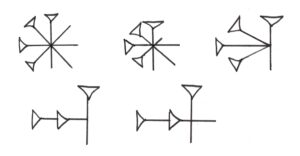
Figure 1.
The sign ĜEŠTUG
As with the cuneiform sign DIĜIR, that we discussed above, ĜEŠTUG can be read as a Sumerian word – multiple words, in fact! – as Akkadian words, and as a number of syllables.26 Like our previous example, the name of the sign is derived from the Sumerian word for the thing, or one of the things, it was thought to originally represent: ĝeštug, meaning ‘ear’. And if we look at my sketch of some of the variants during the evolution of this sign in Assyria (fig. 2), this does not seem all that farfetched!27 This reading, ĝeštug, is also the most important meaning for our purposes. Because this word – and therefore the cuneiform sign – was likewise taken to mean ‘understanding’ or ‘wisdom’. In addition, it could also signify the verb ‘to understand’.28 This is reflected in the Akkadian readings of this sign. The range of meanings attributed to the Akkadian word uznum, for instance, include ‘ear’ as well as ‘awareness’ or ‘wisdom’.29 The sign ĜEŠTUG can thus be said to be related, at least in part, to knowledge.
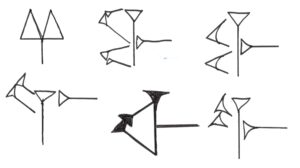
Figure 2.
Most readers will now begin to understand why this sign became the logo for this webpage. As I intend to impart wisdom through the internet, the Sumerian word ĝeštug and the Akkadian word uznum, that were thought to be represented by this sign, fit very well with my purposes. But such wisdom constitutes just a sound in the wind, when it does not reach the ears of those who might learn from it and possibly heed it. As such, the original reading of ĝeštug as ‘ear’ and that same meaning of uznum, are perhaps as significant. While reading clay tablets, though, one should not automatically assume that a text that contains the sign ĜEŠTUG does impart wisdom! As alluded to above, it could also refer to other words or just sounds.
Conclusion
As a former teacher that used to receive student ratings after every course, I am well aware that there is no second chance for a first impression.30 The representation of a phenomenon – be it a teacher, a webpage, or something else entirely – is therefore of the utmost importance for how that phenomenon is perceived. And this justifies, I hope, dedicating an entire blog to the logo of Bildungblocks. With the previously elucidated knowledge, I expect that you agree about the cuneiform sign ĜEŠTUG being a good representation of my writings. Though, now that I think about it… The meaning behind this logo can hardly be the first impression that new readers will have of this webpage, as one needs all this background information about the cuneiform script to be able to appreciate it!
But with other phenomena – most of which I did not name or choose the logo for – one might wonder if the current representation is fit to facilitate an accurate impression at all, even with the warranted background knowledge. This arguably applies to the designation of the Eastern Roman Empire as Byzantine. How this polity acquired that moniker and why we might have good reasons to doubt whether it fits the phenomenon it is taken to signify, is – luckily – the subject of next week’s blog!
References
- Christopher Woods, “The Emergence of Cuneiform Writing”, in: Rebecca Hasselbach-Andee (ed.), A Companion to Ancient Near Eastern Languages (Hoboken: John Wiley & Sons, 2020), p. 27, 33.
- Ibidem, p. 27. Some archeologists propose a much earlier origin for writing and point to signs painted in caves and incisions made on animal bones that have come to us from the ice age, see: Louise Westling, Deep History, Climate Change, and the Evolution of Human Culture (Cambridge: Cambridge University Press, 2022), p. 38, note 14.
- Woods, “The Emergence of Cuneiform Writing”, p. 27; Willemijn Waal, “They Wrote on Wood: The Case for a Hieroglyphic Scribal Tradition on Wooden Writing Boards in Hittite Anatolia”, Anatolian Studies 2011, 61 (1), p. 28.
- Jon Taylor, “Administrators and Scholars: The First Scribes”, in: Harriet Crawford (ed.), The Sumerian World (London: Routledge, 2017), p. 291-292.
- Marc van de Mieroop, A History of the Ancient Near East (Chichester: John Wiley & Sons Inc, 2016), p. 3-6; Mario Liverani, The Ancient Near East: History, Society and Economy, Translated by Soraia Tabatabai (New York: Routledge/Taylor & Francis Group, 2014), p. 5.
- Woods, “The Emergence of Cuneiform Writing”, p. 27.
- Denise Schmandt-Besserat, “Record Keeping Before Writing”, in: Jack M. Sasson (ed.), Civilizations of the Ancient Near East (New York: Charles Scribner’s Sons, 1995), p. 2097-2098, 2100-2101.
- Ibidem, p. 2098.
- Ibidem, p. 2101-2103. For a succinct overview of the development of these tokens and their clay casings, see: Robert Englund, “Accounting in Proto-Cuneiform”, in: Karen Radner & Eleanor Robsen (eds.), The Oxford Handbook of Cuneiform Culture (Oxford: Oxford University Press, 2011), p. 33-35.
- Schmandt-Besserat, “Record Keeping Before Writing”, p. 2101-2103.
- Taylor, “Administrators and Scholars”, p. 291.
- Ibidem.
- Woods, “The Emergence of Cuneiform Writing”, p. 28.
- Ibidem, p. 30-31. Though there were some visual representations from the proto-literary period that made their way into the cuneiform script, see: Piotr Michalowski, “Early Mesopotamian Communicative Systems: Art, Literature and Writing”, in: Ann Gunter, (ed.), Investigating Artistic Environments in the Ancient Near East (Washington: Smithsonian Institution, 1990), p. 59.
- Taylor, “Administrators and Scholars”, p. 293.
- Woods, “The Emergence of Cuneiform Writing”, p. 30-33; Taylor, “Administrators and Scholars”, p. 292.
- Woods, “The Emergence of Cuneiform Writing”, p. 36.
- Ibidem, p. 39.
- Rykle Borger, Mesopotamisches Zeichenlexikon (Münster: Ugarit Verlag, 2003), p. 50.
- Woods, “The Emergence of Cuneiform Writing”, p. 39.
- Andreas Fuls, “Classifying Undeciphered Writing Systems”, Historische Sprachforschung/Historical Linguistics 2015, 128 (1), p. 43; Woods, “The Emergence of Cuneiform Writing”, p. 35-36; Borger, Mesopotamisches Zeichenlexikon, p. 49-50.
- About the matter whether Sumerian was the first language that was written with the cuneiform script, see: Woods, “The Emergence of Cuneiform Writing”, p. 42-44; Gonzalo Rubio, “On the Alleged ‘Pre-Sumerian Substratum’”, Journal of Cuneiform Studies 1999, 51 (1), p. 1-16.
- Catherine Mittenmayer, Altbabylonische Zeichenliste der Sumerisch-Literarischen (Göttingen: Vandenhoeck, Ruprecht, 2006), p. 5-6; Fuls, “Classifying Undeciphered Writing Systems”, p. 43.
- Taylor, “Administrators and Scholars”, p. 293.
- See also: René Labat, Manuel d’Épigraphie Akkadienne: Signes, Syllabaire, Idéogrammes (Paris: Librairie Orientaliste Paul Geuthner, 1994), p. 48-49.
- The modern designation of this sign differs, with many contemporary sign lists denoting it as PI instead of ĜEŠTUG. And there are solid arguments for this designation, including the reading as PI in Akkadian texts, where it signified the Akkadian word pānu, and the fact that the syllable /pi/ is one of the sounds that the sign most frequently represented, see: Mittenmayer, Altbabylonische Zeichenliste der Sumerisch-Literarischen, p. 145; Labat, Manuel d’Épigraphie Akkadienne, p. 176-177; Borger, Mesopotamisches Zeichenlexikon, p. 165.
- See also: Labat, Manuel d’Épigraphie Akkadienne, p. 176-177.
- John Alan Halloran, Sumerian Lexicon: A Dictionary Guide to the Ancient Sumerian Language (Los Angeles: Logogram Publishing, 2006), p. 98. Another reading of ĜEŠTUG , the Sumerian word tal2, is also connected to this meaning, see: Ibidem, p. 273.
- John Huehnergard, A Grammer of Akkadian, (Winona Lake, Eisenbrauns, 2005), p. 529; Jeremy Black, Andrew George & Nicolas Postgate (eds.), A Concise Dictionary of Akkadian (Wiesbaden: Harrassowitz Verlag, 2000), p. 431. As might be expected by now, these are far from the only meanings attributed to this Akkadian word, see: Martha T. Roth, 2010, The Assyrian Dictionary – Volume 20: U and W (Chicago: The Oriental Institute, 2010), p. 362-371.
- Preeti Samudra et al, “No Second Chance to Make a First Impression: The ‘Thin-Slice’ Effect on Instructor Ratings and Learning Outcomes in Higher Education’, Journal of Educational Measurement 2016, 53 (3), p. 313.