Apparently the people I’m surrounded by, care more about me than I ever dared hope for. Because, at the beginning of this month I was surprised with the beautiful new book The New Roman Empire: A History of Byzantium by Anthony Kaldellis.1 Within its tasteful red cover one can find more than a thousand pages of the good stuff: an engagingly written, thoroughly researched and amply annotated history of the Eastern Roman Empire. And already on the first few pages Kaldellis makes a very interesting point. Despite the subtitle of that very volume, he postulates that the moniker ‘Byzantine’ is maybe not a good fit for the Eastern Roman Empire.2 And considering that by all accounts you lot cannot seem to stop thinking about the Roman Empire, I want to take the time today to explain how the Eastern Roman Empire became Byzantine.3
This explanation is largely based on Kaldellis’ further work on the subject.4 I forego, however one of his recommendations regarding the terminology that is preferably to be used in such a venture, despite that I agree on principle. Throughout this blog, I employ the designation ‘Eastern Roman Empire’, even though that term is hardly appropriate after the period in which there was a western counterpart.5 I have chosen this approach nonetheless, as to not confuse the reader and in order to attract those on the web who innocuously seek information about these matters and are, as yet, unlikely to use search terms like ‘New Roman Empire’.
This blog is also available in Dutch.
The New Roman Empire
As with our foray into cuneiform last week, it is safe to say that almost everything regarding the Roman Empire is complicated – and famously so. There is a myriad of moments that are proposed for the so-called fall of the Roman Empire, for example.6 And many of these tend to ignore that, in the Eastern Mediterranean, a polity where the people considered themselves Romans and believed to live in Romania, continued to exist until the very cusp of modernity7 That seems odd, right? Well, it all has to do with the history of the Roman Empire – the original, that is – in the third century CE.
During this time, Roman emperors increasingly had to focus on the defense of the frontiers of their dominion.8 Many emperors spent more time with their armies than in Rome itself. And it was already during the short reigns of Macrinus (217-218 CE) and Maximinus I (235-238 CE) that we see emperors who never set foot in the eternal city while being on the job.9 Due to these absences, the idea took root that Rome is where the emperor happens to be. As Rome, the idea of it, had become a common fatherland for many of the inhabitants of the empire. A city that had enveloped an entire world, the orbis Romanus.10 And a flurry of emperors, deemed legitimate or otherwise, proclaimed to hold court in their own proxy-Romes in the provinces.11 Including Gordian III, who in 238 CE made the bold decision to proclaim the abode of the former arch-enemy of the Romans, the city of Carthage, a surrogate for Rome!12
Just as the city of Rome could be duplicated, the position of emperor was multiplied.13 The ‘tetrarchy’, a system implemented by Diocletian who ascended the throne in 248 CE, envisioned two senior augusti and two junior caesares, who each were to hold and defend portions of the empire.14 It is significant that Diocletian, as the most powerful person in this arrangement, chose the eastern parts of the empire for himself.15 And this pre-eminence of the east was solidified by the later emperor Constantine (324-337 CE) who briefly became the sole ruler of what remained of the Roman Empire, though he kept the essentials of Diocletian’s system in place.16
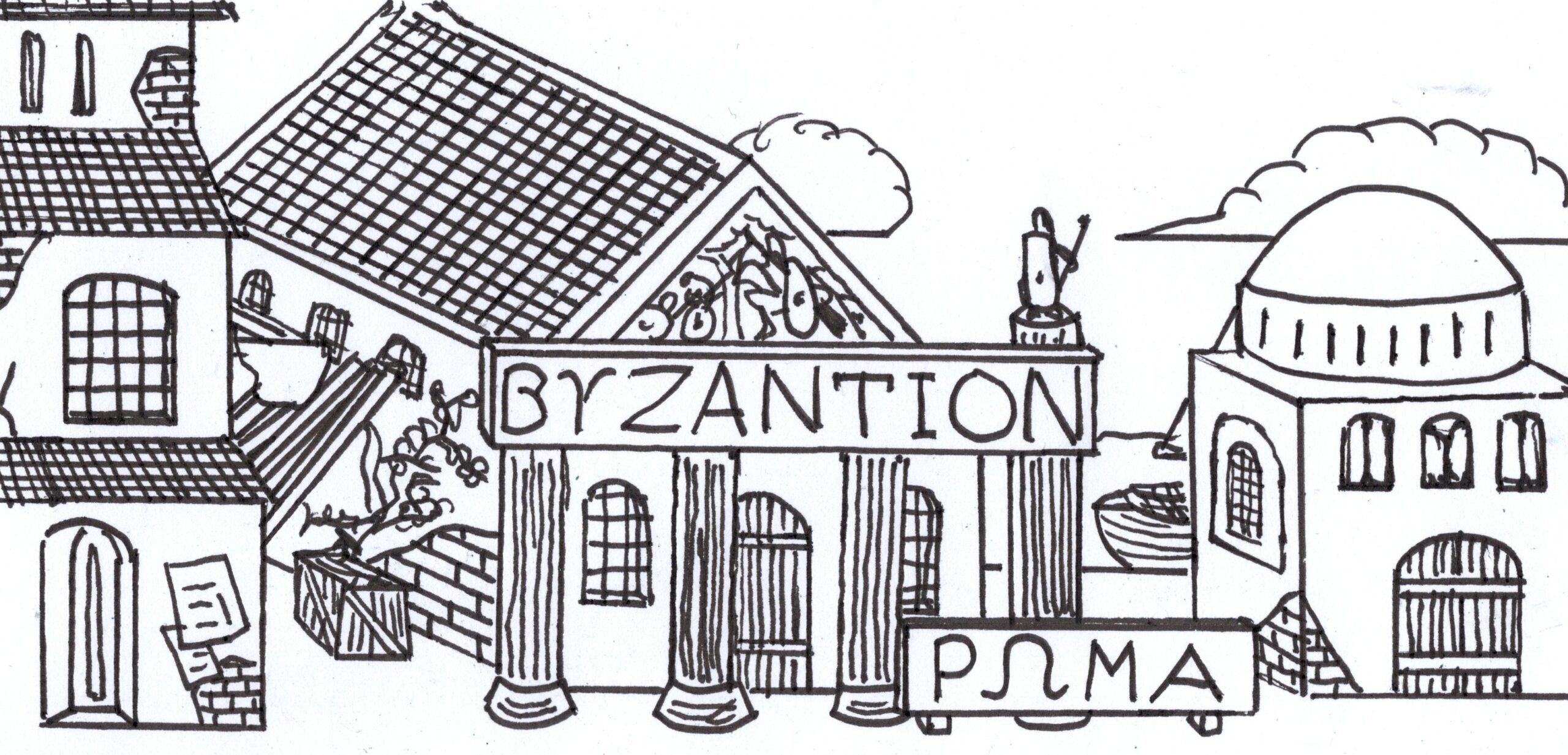
Constantine also declared a new Rome from which he went on to govern. And this involved expanding the ancient city of Byzantion on the Bosporus into a fabulous metropolis, which was renamed Constantinople in 330 CE.17 Contrary to the other surrogates for Rome, Constantinople remained the focal point of the empire after the death of Constantine. The city could therefore rightly be called the New Rome, even while the hold of the Romans on the west became increasingly tenuous.18 And this relative alienation from the west or the loss of Rome itself did therefore not meaningfully impact the self-image of the inhabitants of the east as Romans.
Romania
Because, make no mistake. The inhabitants of the eastern parts of the Roman Empire had been considered Romans for a very long time and continued to perceive themselves as such. They styled themselves as Romans, or Romaioi in Greek, and Kaldellis reasons that the name for the lands which they inhabited had been Romania long before it became an official designation around the fourth century CE.19 The rise of new polities to the west, throughout what used to be the parts of the earlier Roman Empire, however, led to competing rulers who had a vested interest in denying the remaining Romans that very designation.20 Mostly because they aimed to use the legacy of Rome as a means to legitimize their own regimes.
This was not an immediate development. Throughout late antiquity and until the eighth century CE, the Eastern Roman Empire was generally acknowledged as the Roman state and often approached as such.21 But in 800 CE the sovereign of Francia, Charlemange was crowned emperor by the pope and this coveted title remained in circulation in those parts of Europe until the abolishment of the Holy Roman Empire in the early nineteenth century CE.22 Accompanying these developments where theories of empire and the right to rule, which were at least in part based on the idea that these rulers were heir to the Romans. But in order to tap this source of legitimacy, one needed to deny the continuation of the Roman Empire in the east its ‘Romanness’, so to say.23
The Empire of the Greeks
You might have noticed that in the preceding I mentioned the name ‘Byzantion’ only once, as the name of the city that would become Constantinople. That is because this moniker was not the first label that was put upon the Eastern Roman Empire by the polities to her west. The earlier strategies to deny New Rome its ‘Romanness’ emphasized that its inhabitants mostly spoke the Greek language instead of Latin. Greek had of course been an important language in de ‘old’ Roman Empire, and it was regularly spoken by its elites.24 As such, speaking Greek had, until then, never meant that one was less of a Roman.25 But some polities to the west now latinized the heritage of Rome, and proclaimed the New Rome to be merely an empire of Greeks.26
And that label, the Empire of the Greeks, stuck throughout the Middle Ages and beyond. This was a period in which the Eastern Roman Empire and the polities to the west of it increasingly drifted apart.27 Culminating in the conquest and sack of Constantinople in 1204 CE during the fourth crusade, which even led to a temporary Latin Empire largely taking its place.28 All the while, the matter of who was heir to the legacy of Rome continued to be contested. The fourteenth century CE Italian proto-humanist Petrarch, for instance, chided the Eastern Roman Empire for the gal to call themselves Romans.29 And after the Ottoman conquest of Constantinople in 1453 CE, which was since 1261 CE once again ruled by the Eastern Roman Empire, it was not the Romans who were bemoaned in the western polities that neighbored them. They lamented the sad fate of the Greeks.30
Nowadays, the fall of Constantinople to the Ottomans is often not considered the actual fall of the Roman Empire in the east. As the Ottoman dynasty itself asserted, amongst other claims, that they carried on with the Roman Empire and its legacy, as it had continued to exist in the east.31 And many of the people who inhabited their domain continued to consider themselves Romans. This self-identification only definitively began to abate in the early nineteenth century CE.32
The Byzantine Empire
And it is the decline of the continuing idea of a Roman identity in the former domains of the Eastern Roman Empire during the nineteenth Century CE that finally mainstreamed the designation of that polity as being Byzantine. Because, when the Greeks sought their independence from the Ottoman Empire, many of their leaders did not harken back to their past as Romans, but to Classical Greece.33 And although this brought them the support of the great powers of Europe at the time, these benefactors were also slightly worried. Because, if the Greeks wanted to lay claim to the famed ‘Empire of the Greeks’, they would also covet lands in which these powers had vested interests.34 As such, a new – or, even better, an old – designation was needed for the Eastern Roman Empire.
The adjective ‘Byzantine’ for the so-called Empire of the Greeks was not novel. The Romans themselves had referred to their dominion as the Empire of Byzantion, though they primarily meant the city itself. And it had been used sporadically within the scholarly research and adjacent publications on this polity that followed the fall of Constantinople in 1453 CE.35 It was this relatively obscure label that now made rapid inroads and proved a mainstay with professional historians throughout much of the nineteenth and twentieth centuries.36 One can even read relatively recent debates between historians about when the Eastern Roman Empire actually became Byzantine.37 In this time the Romans of the east were often identified primarily through their religion, mostly orthodox Christianity, instead of with their own ideas of their political identity.38 And these notions were accompanied, explicitly or implicitly, by some of the prejudices with regards to the inhabitants of the Eastern Roman Empire that had been around since the time that it was designated as the Empire of the Greeks.39 For instance, a perfidious effigy of the Empire was erected by some Enlightenment thinkers, such as Voltaire, as a surrogate through which they could criticize the rulers of contemporary polities, without angering some very important and influential people.40 And we can recognize the enduring power of such predispositions in the commonplace that something is ‘Byzantine’ when it is “needlessly complicated, convoluted, intricate, or with a sinister ulterior motive.”41 Some scholars, though, kept pointing to the ridiculousness of the longevity of such assessments, as well as advocating for the Roman underpinnings of the so-called Byzantine Empire.42 And maybe their pleas now have the tide of history behind them? Because the matter even reaches obscure blogs on the information superhighway, like my own – that you are currently reading!
Conclusie: Retiring the Byzantines?
Throughout the works that I mostly cited in this blog, Anthony Kaldellis forcefully asserts that we should retire the all too recent moniker of ‘Byzantium’, as well as the prejudices that often accompanied this designation, for a more fitting description of the polity that continued the Roman Empire in its eastern dominions.43 And I find myself agreeing with him, even though I unthinkingly used the term not too long ago. So, long live the Eastern or – perhaps more accurately – New Roman Empire!
But, alas… However one wants to try and prolong its existence, even if you include the Holy Roman and Ottoman Empires, the Roman Empire – east or west, old or new – is irrevocably gone.44 And this is perhaps a melancholic reminder that, in time, everything ends. Our lives, our polities, our favorite tv-series, and maybe even the very universe we inhabit. Next week, we will continue this theme and explore the reasons we fear death and the connection of these reasons to the human condition, through the works of Thomas Nagel and Martha Nussbaum.
References
- Anthony Kaldellis, The New Roman Empire: A History of Byzantium (Oxford: Oxford University Press, 2024).
- Ibidem, p. 2-3.
- Rosanne de Jong, “Dromen van het Romeinse Rijk”, Haarlems Dagblad October 6th 2023, Wijzer, p. 22-23.
- His most important works on this subject, in addition to The New Roman Empire, are: Anthony Kaldellis, Byzantium Unbound (Leeds: Arc Humanities Press, 2019); Anthony Kaldellis, Hellenism in Byzantium: The Transformations of Greek Identity and the Reception of the Classical Tradition (Cambridge: Cambridge University Press, 2007).
- Kaldellis, The New Roman Empire, p. 931, note 5.
- Ian N. Wood, “When Did the West Roman Empire Fall?”, in: Walter Pohl & Veronika Wieser (eds.), Emerging Powers in Eurasian Comparison, 200–1100: Shadows of Empire (Leiden: Brill, 2022), p. 55. And then there is also the adjacent debate when antiquity gave way to the Middle Ages, see: Matthew Gabriele & David M. Perry, The Bright Ages: A New History of Medieval Europe ( Auckland: Harper Perennial, 2022), p. x-xi
- Kaldellis, Byzantium Unbound, p. 44. Romania was also known as Roméika in the local vernacular, see: Kaldellis, The New Roman Empire, p. 3.
- Ibidem, p. 17-19.
- Oliver Hekster, Rome and Its Empire, AD 193-284 (Edinburgh: University of Edinburgh Press, 2008), p. 3.
- Kaldellis, The New Roman Empire, p. 20.
- Ibidem.
- Ibidem.
- Ibidem.
- Frits Naerebout & Henk Singor, De Oudheid: Grieken en Romeinen in de Context van de Wereldgeschiedenis (Amsterdam: Ambo, 2010), p. 360; Kaldellis, Byzantium Unbound, p. 46.
- Roger Rees, Diocletian and the Tetrarchy (Edinburgh: University of Edinburgh Press, 2013), p. 6.
- Naerebout & Singor, De Oudheid, p. 360.
- Kaldellis, The New Roman Empire, p. 11.
- Gabriele & Perry, The Bright Ages, p. 20-21.
- Kaldellis, Byzantium Unbound, p. 8; Kaldellis, The New Roman Empire, p. 20-21.
- Francesco Borri, “The Lagoons as a Distant Mirror: Constantinople, Venice and the Italian Romania”, in: Walter Pohl & Veronika Wieser (eds.), Emerging Powers in Eurasian Comparison, 200–1100: Shadows of Empire (Leiden: Brill, 2022), p. 197.
- Kaldellis, Byzantium Unbound, p. 3.
- Ibidem, p. 3-4.
- Ibidem, p. 5.
- Ibidem, p. 8-9.
- Kaldellis, Hellenism in Byzantium, p. 44-45.
- Kaldellis, Byzantium Unbound, p. 9.
- Ibidem, p. 9-11.
- Norman Davies, Europe: A History (London: The Bodley Head, 2014), p. 359-360.
- Kaldellis, Byzantium Unbound, p. 13. For Petrarch, see: Jeffrey Michael Hunt, Riggs Alden Smith & Fabio Stok, Classics from Papyrus to the Internet: An Introduction to Transmission and Reception (Austin: University of Texas Press, 2017), p. 150-158.
- Kaldellis, Byzantium Unbound, p. x, 14.
- Einar Wigen, “Ottoman Concepts of Empire”, Contributions to the History of Concepts 2013, 8 (1), p. 49.
- Kaldellis, Byzantium Unbound, p. 44.
- Though this was not universally endorsed, see: Ibidem, p. 22; Kaldellis, Hellenism in Byzantium, p. 14.
- Kaldellis, Byzantium Unbound, p. 20-24.
- Ibidem, p. 15.
- Kaldellis, The New Roman Empire, p. 3.
- Davies, Europe, p. 239.
- Kaldellis, Hellenism in Byzantium, p. 44, 105; Kaldellis, The New Roman Empire, p. 2-3.
- Kaldellis, Byzantium Unbound, p. 20-25.
- Ibidem, p. 19; Kaldellis, The New Roman Empire, p. 2.
- Kaldellis, Byzantium Unbound, p. 25.
- Ibidem, p. 1-2, 6, 26-28. But see also: Ibidem, p. 43.
- Kaldellis, The New Roman Empire, p. 2-3; Kaldellis, Byzantium Unbound, p. 1-2.
- Davies, Europe, p. 733, 937-938.